Page of Play
Players perform a scene as if it were a literal “page of play” from a script. This means they are aware of stage directions, character names, and dialogue cues as if reading from an unseen script, even though they are improvising. The humor often comes from the meta-awareness of the theatrical form.
Pan Left
Two or three actors stand on a back line, with two others in front, all facing the audience, representing a TV channel. If “Pan Left” is called, everyone moves one place, revealing a new TV channel at the front.
Paper Chase
Lines of dialogue are written on slips of paper and scattered over the stage. At intervals, players pick up a slip and read it as their line, then justify it.
Paperclip Game
One player holds a paperclip. They must demonstrate as many unexpected and creative uses for the paperclip as possible, verbally justifying each new use. This is a quick exercise in object work and creative association.
Papers
This game involves players interacting with imaginary papers that reveal surprising or absurd information. For example, a character might find a mysterious note, a bizarre legal document, or a child’s drawing that drives the scene in an unexpected direction.
Paradox of Improvisation
This refers to exploring the inherent paradox in improvisation: the act of spontaneously creating something that often appears pre-planned or structured. Exercises around this theme encourage players to embrace the unknown, accept offers fully, and trust that coherence will emerge from chaos without prior design.
Parallel Universe
Players perform a scene that, at any moment, can shift into a parallel universe. When a facilitator or another player calls out “Parallel Universe!”, the existing scene continues, but with a subtle or drastic change to one or more elements (e.g., characters’ personalities, objects’ functions, the laws of physics), which the players must immediately justify.
Party
A classic improv game where one player acts as the host of a party. The audience suggests different types of guests (e.g., someone who’s afraid of balloons, a famous historical figure, someone who speaks only in rhymes). The guests enter one by one, embodying their characters, and the host tries to identify their quirk or identity through interaction.
Party Hoppers
Players are assigned to a breakout room with a particular theme (e.g., mythological characters, teenage stereotypes, infamous historical figures). Players create a character and interact with groupmates.
Party Quirks
One player is the “host” of a party. Other players are “guests,” each secretly assigned a quirky character trait or identity (e.g., “You think you are Spider-Man,” “Every time someone smiles, you jump up and down,” “You only speak in rhymes”). The host interacts with the guests, trying to guess each person’s quirk based on their improvised behavior.
Players stand in a circle and pass an imaginary ball around. The focus is on precision and consistency in mime; each player must “receive” and “throw” the ball with the same weight and characteristics established by the first player (e.g., a heavy bowling ball, a light beach ball, a sticky blob).
Pass Clap
Players stand in a circle. One player initiates a clap and simultaneously directs it towards another player with a specific gaze or gesture. The designated player then immediately “receives” the clap and “passes” it on to someone else. The game speeds up, requiring quick reactions and clear communication.
Pass-Off Scene
Also known as “Follow the Leaver,” this game creates a longer narrative piece by having the action follow a character as they exit a scene. When a character leaves, the scene follows them to a new location, and any remaining characters in the original location stealthily exit the stage.
Participants form a large circle. One player initiates a small gesture and sound. The next player attempts to replicate it, and this continues around the circle. The gesture and sound are expected to subtly transform as they pass from person to person, and subsequent players must accept and incorporate these changes.
Pass Yes
Players stand in a circle. One player initiates a gesture and says “Yes!” to the person next to them. The next person receives the “Yes,” repeats it with their own gesture, and passes it along. The game often increases in speed, emphasizing quick acceptance and commitment to offers.
Passion Statements
Players create a scene where their characters are incredibly passionate about something, no matter how mundane or absurd. They express their “passion statements” with exaggerated emotion and conviction, leading to humorous overreactions and heightened scenes.
Patterns
This is an exercise or game where players focus on identifying and developing patterns within a scene or series of scenes. This could involve recurring lines, actions, themes, or character behaviors. Once a pattern is established, players can either continue it, break it, or heighten it for comedic or dramatic effect.
Pauze
Similar to “Freeze Tag” or “Director’s Cut,” the facilitator calls out “Pauze!” (a play on “pause”). All players in the scene immediately freeze in place. The facilitator might then give an instruction, ask for a suggestion, or simply restart the scene, encouraging players to be constantly ready for interruption and change.
Pecking Order
Players improvise a scene where the underlying dynamic is a clear, yet unspoken, pecking order or status hierarchy. Characters must subtly (or overtly) establish and maintain their position within this hierarchy, leading to power struggles, deference, or rebellion based on their perceived status.
Perspectives
A scene is played, and then replayed multiple times, each time from the distinct perspective of a different character involved. Each replay emphasizes that character’s biases, internal thoughts, and how they perceive the events and other characters, revealing layers of the narrative.
Peruvian Ball Game
Players stand in a circle and pass an imaginary ball (or energy) around. The key is that they must make a specific sound and motion as they pass it, and the receiver must make a different, but complementary, sound and motion as they receive it. This rhythmic game requires sharp focus and listening.
Phonebank
Players portray telemarketers, customer service agents, or other individuals working in a phonebank setting. The scene involves multiple overlapping, often humorous, phone conversations happening simultaneously, requiring players to maintain their individual calls while being aware of the collective soundscape.
Phone Conversations
All players are talking on phones, and during the scene, they give and take focus, usually revealing some overlapping stories.
Physical Exaggeration
Players are given an odd physical characteristic as the basis for their character. This focuses on physical characterization and using physical limitations as inspiration.
Physical Thermometer
Players improvise a scene where the physical intensity or energy must constantly change in response to an imaginary “thermometer” or scale. A facilitator might call out numbers (e.g., “level 2,” “level 8”), and players must adjust their movements, gestures, and vocal energy to match the new level, moving from subtle to extreme.
Piano Torture
One player acts as a “pianist” who is clearly struggling or deliberately playing badly. Other players in the scene must react to this “torturous” piano playing, justifying their reactions (e.g., covering their ears, trying to offer encouragement, pretending to enjoy it), leading to comedic interactions.
Picture Book
A storyteller turns pages of a storybook, with players presenting the random picture (tableau), which the storyteller justifies.
Pick-Up Lines
Players are given a scenario (e.g., a bar, a grocery store). They then attempt to use increasingly elaborate, humorous, or bizarre pick-up lines on each other, with the scene unfolding based on the reactions to these attempts.
Piece of Cheese
In a circle, one person hops out and says “I’m a piece of cheese” and embodies it. One by one, other improvisers come out and become obvious things that go with that offer, forming one united picture.
Two people play a scene, with two audience members (“pillars”) on either side. The pillars provide one word when tapped on the shoulder. Players in the scene “forget” words and tap a pillar for a word to finish their sentence. The player must incorporate and justify the word, even if it’s weird.
Ping Pong Ballad
Two players face each other as if playing ping-pong, but instead of hitting a ball, they are lyrically “hitting” phrases or ideas back and forth, building a spontaneous ballad or song together. The rhythm of the ping-pong game dictates the flow of the song.
Play Tag
This is a physical warm-up game similar to traditional tag, but with an improv twist. When a player is tagged, they might have to freeze in a specific pose, take on a new character, or start a short scene that the next “it” player must join or react to.
Player Interview
One player acts as an interviewer, and another player is interviewed as a character. The interview focuses on the character’s backstory, motivations, or experiences related to a suggestion. This game allows for deep character exploration and rapid information sharing.
Poet Translator
Similar to “Poetry Translation,” one player performs a poem (often in gibberish or a dramatic, abstract style), and another player immediately translates it into English, creating a coherent, often humorous, interpretation.
Poet’s Corner
Players gather in a designated “poet’s corner” and take turns performing impromptu poems based on audience suggestions or themes that emerge from the scene. The poems can be serious, comedic, rhyming, or free verse.
Poetry Corner
(Same as Poet’s Corner) This emphasizes a dedicated segment of an improv show or workshop where players showcase their ability to create spontaneous poetry, often drawing on themes or words from earlier scenes.
Poetry Translation
A foreign poet reads one of his famous poems (in gibberish), and a translator provides the English version.
Point/Counterpoint
Two players express opposing points of view on a given topic, engaging in a debate or discussion. The game focuses on maintaining a strong stance and finding creative ways to argue their side, even if the arguments become absurd.
Point of View
A simple scene is improvised, then replayed from the point of view of different characters, exaggerating emotions/actions based on relationships.
Popcorn
A rapid-fire word association warm-up. Players sit in a circle. One player says a word, and the next player immediately says a word that pops into their head in response, without pausing or editing. The goal is speed and spontaneity, letting ideas “popcorn” from one to another.
Pop-Up Story Book
Choose a narrator, and split the class in half: one group acts out the story, and one group is the audience. Onstage actors “pop up” from a lying position as the narrator tells a story. The narrator may “pull the tab” or “turn the wheel” to add action.
Presents
This game involves characters giving and receiving imaginary presents. The giver defines the gift through their mime and enthusiasm, and the receiver must react genuinely to the gift, no matter how strange or unexpected, and justify its existence.
Presentational Group Song
The entire group improvises a song together, often with a clear beginning, middle, and end, and a distinct style (e.g., Broadway, pop, gospel). The song is performed in a presentational style, directed towards the audience, as if it were a finished musical number.
Press Conference
One player is an important figure (e.g., a celebrity, politician, inventor) who is holding a press conference. Other players act as reporters, asking questions about a suggested topic or recent event. The “important figure” must answer all questions, justifying any absurd details that emerge.
Press Conference Endowments
Similar to “Press Conference,” but the audience or facilitator subtly provides endowments (hidden traits, secrets, or motivations) to the “important figure.” The reporters’ questions and the figure’s answers then reveal these endowments throughout the press conference.
Primal Screams
This is a vocal warm-up or stress-release exercise. Players are encouraged to let out loud, uninhibited “primal screams” or vocalizations, often guided by a facilitator who sets different tones or intensities. It helps to loosen vocal cords and release tension.
Prologue
Players improvise a prologue to a larger, unseen story. This short scene sets the tone, introduces a key theme, or hints at a conflict, without fully revealing the entire plot, leaving the audience with a sense of anticipation.
Psychiatrist
One player is a psychiatrist, and another is a patient. The patient has a specific, often unusual, mental quirk or delusion (suggested by the audience or facilitator). The psychiatrist must attempt to understand and “cure” the patient, leading to humorous interactions.
Pulse
Players stand in a circle and pass an invisible pulse (a small, sharp clap or finger snap) around the circle at a consistent rhythm. The goal is to maintain the shared rhythm and focus, with mistakes causing the pulse to reset. This is a foundational exercise for group mind and timing.
Puppets
One or more players are human puppets, able to speak but unable to move unless a puppeteer moves them. This develops physical control, mime, and collaborative physical storytelling.
Questions Only
Two or more actors perform a scene speaking exclusively in questions. The group first decides on a scenario. The game can be made competitive by deducting points or eliminating players for hesitating or making statements.
Question-Statement
Players take turns to speak. Each player holds the turn until they ask a question. This structures dialogue, encourages clear offers, and promotes listening for conversational cues.
Question Time
At any point, the audience can call “Question!” and ask a question about the scene (e.g., “Your character seems really angry. Why is that?”). The player’s answers affect how the scene unfolds.

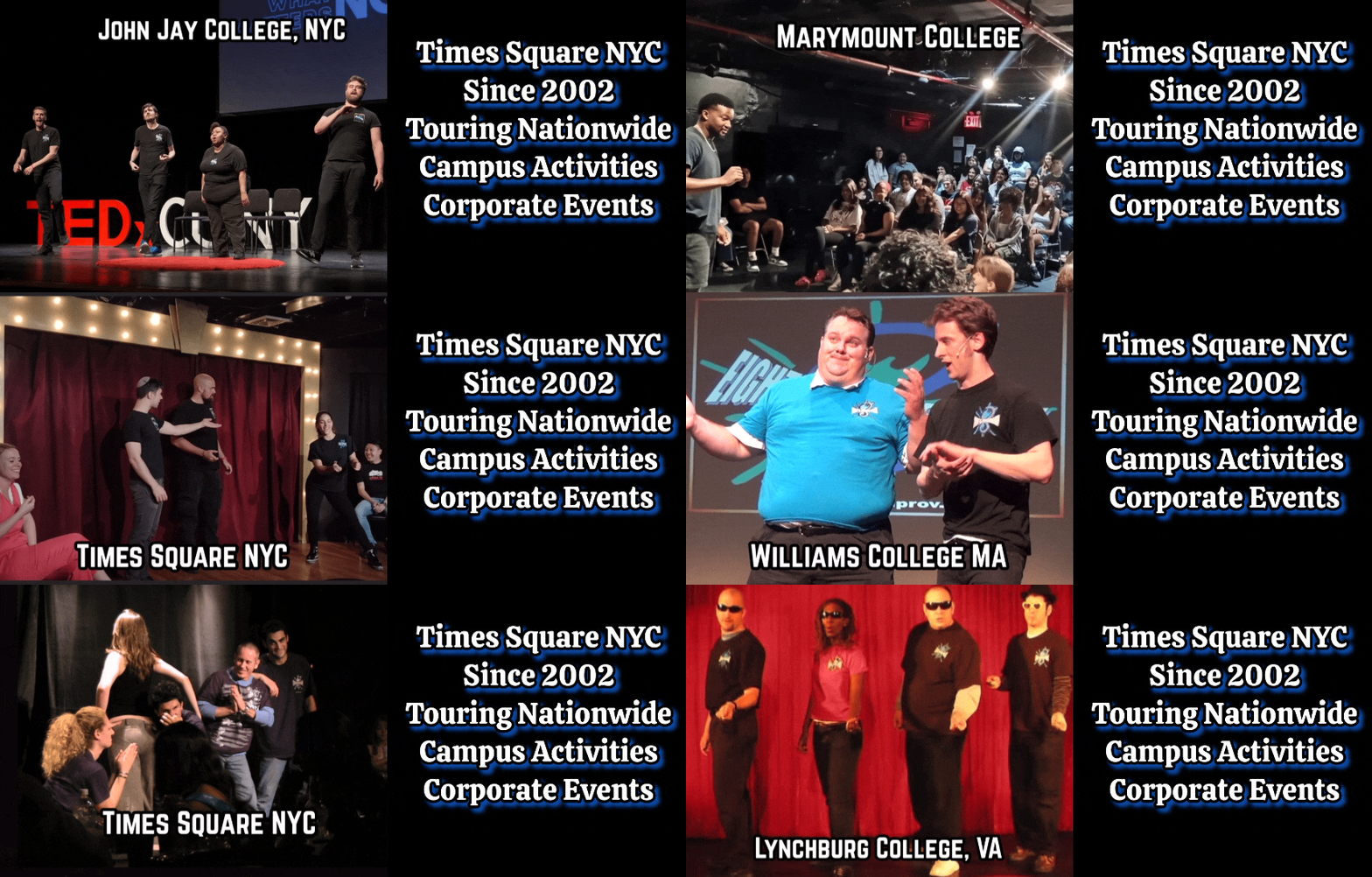
Join us for weekly shows, classes and jams. We daily host corporate teams and student groups at our Times Square NYC theater as well as tour schools, community centers, and private events DC to Boston to Pittsburg and beyond! CLICK HERE for upcoming public shows. CLICK HERE for upcoming classes & jams. EMAIL for information regarding private shows & group sales.


You must be logged in to post a comment.